GTA Real Estate Market Update October 2026: Home Prices Show Early Signs of Stabilization

Adam Cui > Blogs > GTA Real Estate Market Update October 2026: Home Prices Show Early Signs of Stabilization

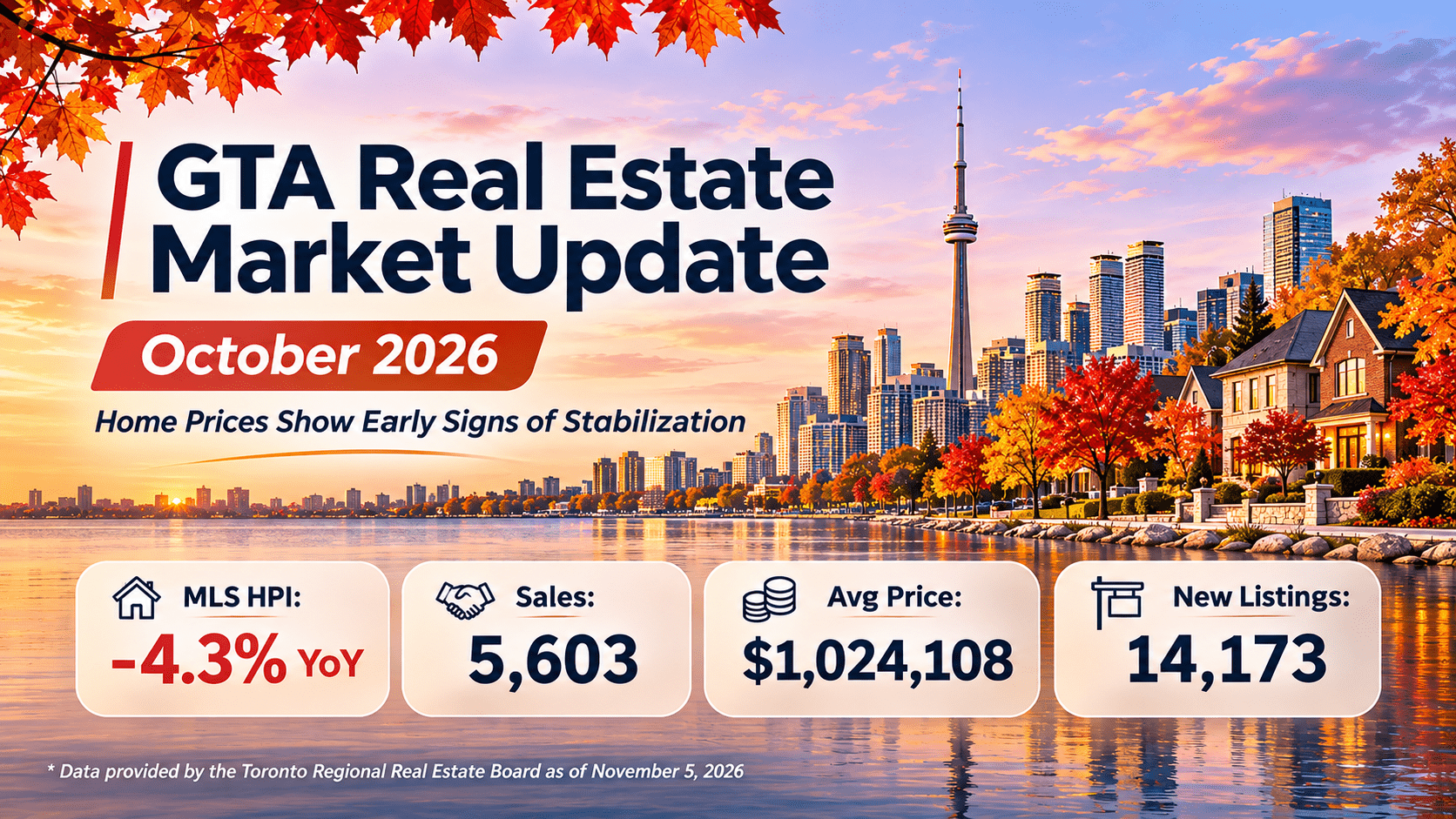
The GTA real estate market in October 2026 is showing some interesting signs of change. After months of uncertainty, home sales and prices improved compared with September, while the MLS Home Price Index (HPI) recorded a smaller year-over-year decline. According to the Toronto Regional Real Estate Board (TRREB), the market is still facing challenges, but these latest numbers suggest that conditions may be gradually stabilizing. So, is this the beginning of a housing market recovery, or just a temporary improvement?

In this October 2026 GTA Housing Market Report, we will take a closer look at the latest home prices, sales activity, housing inventory, and market trends across Toronto, York, Peel, Halton, and Durham Regions. We will also explore key cities, including Mississauga, Brampton, Markham, Vaughan, Richmond Hill, Oakville, Burlington, Milton, and Durham communities, while comparing detached homes, townhouses, and condos. Most importantly, we will break down what these changes actually mean for homebuyers, sellers, and real estate investors, helping you navigate today’s GTA housing market with greater confidence.

Follow Us On

1. GTA Housing Market 2026: Has the Market Finally Started to Turn?

The Greater Toronto Area housing market has experienced an uneven year in 2026. After a sluggish start, spring brought some improvement in buyer activity. However, the recovery struggled to maintain momentum through the summer and into September.

October has brought a more encouraging development.

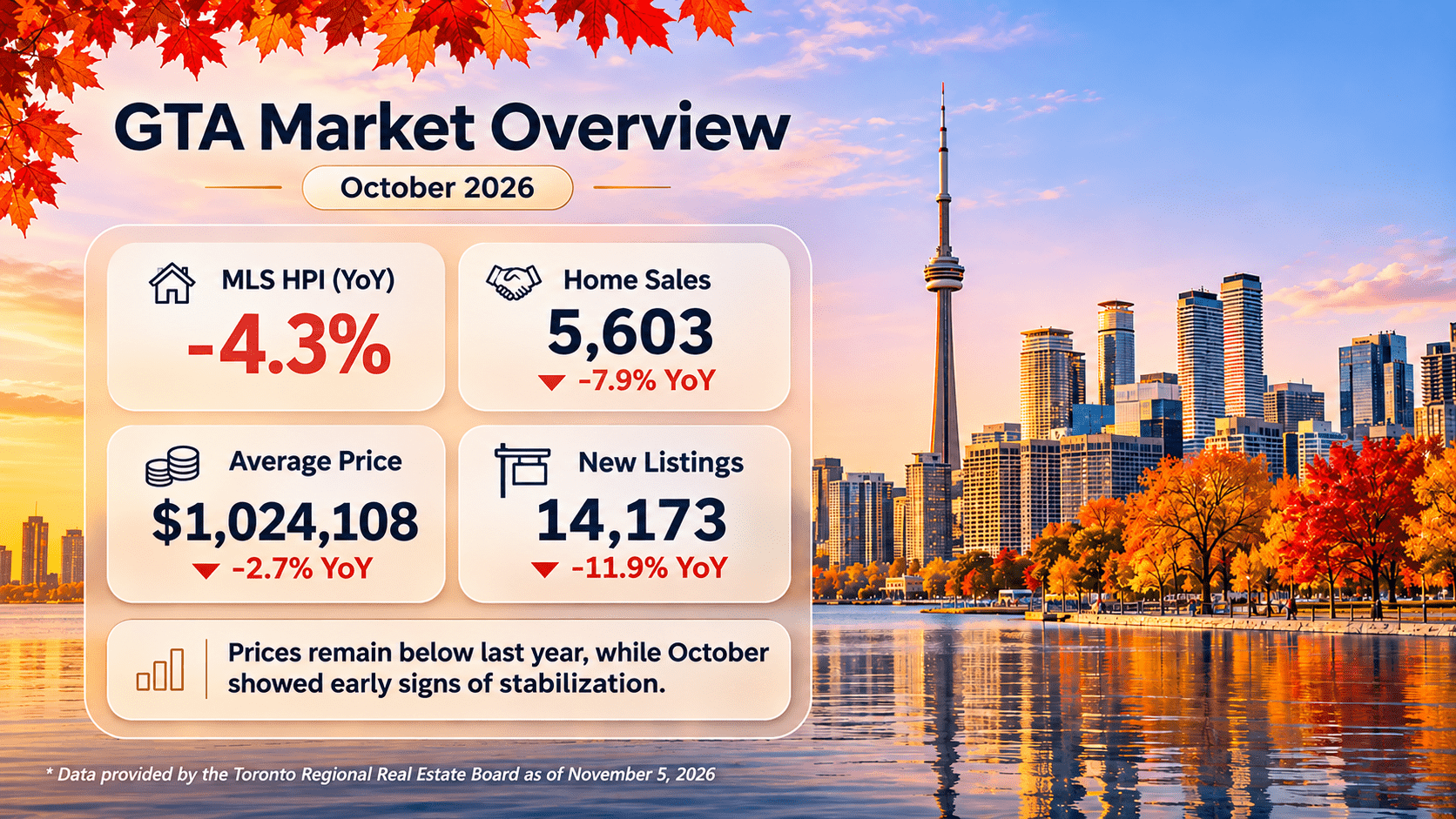
According to the Toronto Regional Real Estate Board (TRREB), 5,603 homes sold across the GTA in October 2026, down 7.9% from the same month last year. Meanwhile, the average selling price reached $1,024,108, representing a 2.7% year-over-year decline.

Most importantly, the MLS Home Price Index (HPI) Composite benchmark fell 4.3% compared with October 2025.

Although prices remain below last year’s levels, this decline was smaller than September’s 4.7% drop.

In addition, TRREB reported that seasonally adjusted sales, new listings and home prices all improved from September.

So, does this mean the GTA housing market has officially reached its bottom?

Not quite. One month of improvement does not establish a long-term trend. Nevertheless, October offers some evidence that the market may be moving toward greater stability.

2. GTA Home Prices: Why MLS HPI Matters More Than the Average Selling Price

When discussing real estate trends, the average selling price is often the first number people notice. However, it is not always the best indicator of whether a typical property has gained or lost value.

For example, if more luxury detached homes sell in one month, the average selling price could increase even if comparable homes have not become more expensive.

That is why the MLS HPI Benchmark deserves more attention.

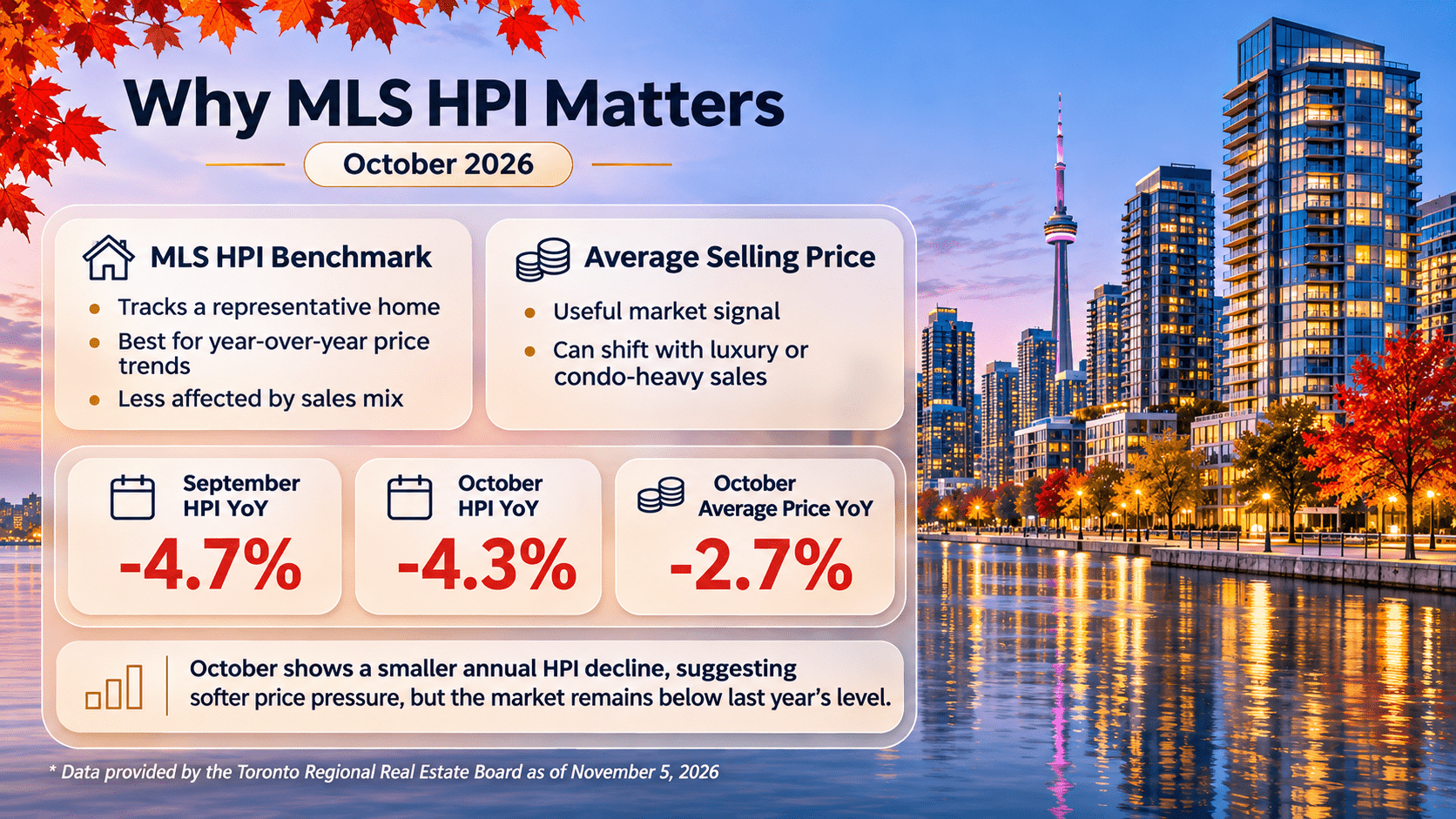
The HPI measures changes in the value of representative properties, adjusting for differences in housing characteristics. This makes it particularly useful for comparing housing prices over time.

In September 2026, the GTA HPI Composite benchmark was down 4.7% year over year. In October, that decline narrowed to 4.3%.

The improvement of 0.4 percentage points is modest, but meaningful.

It suggests that annual price declines are becoming somewhat less pronounced.

At the same time, buyers should not confuse a slower decline with a confirmed price recovery. Home values remain below October 2025 levels, and additional monthly data will be needed to establish whether the improvement can continue.

For homeowners who want a more accurate understanding of their property’s value, local real estate market analysis should combine relevant HPI trends with recent comparable sales, current competition and property-specific features.

3. October vs. September 2026: Sales Recover While New Listings Remain Below Last Year's Level

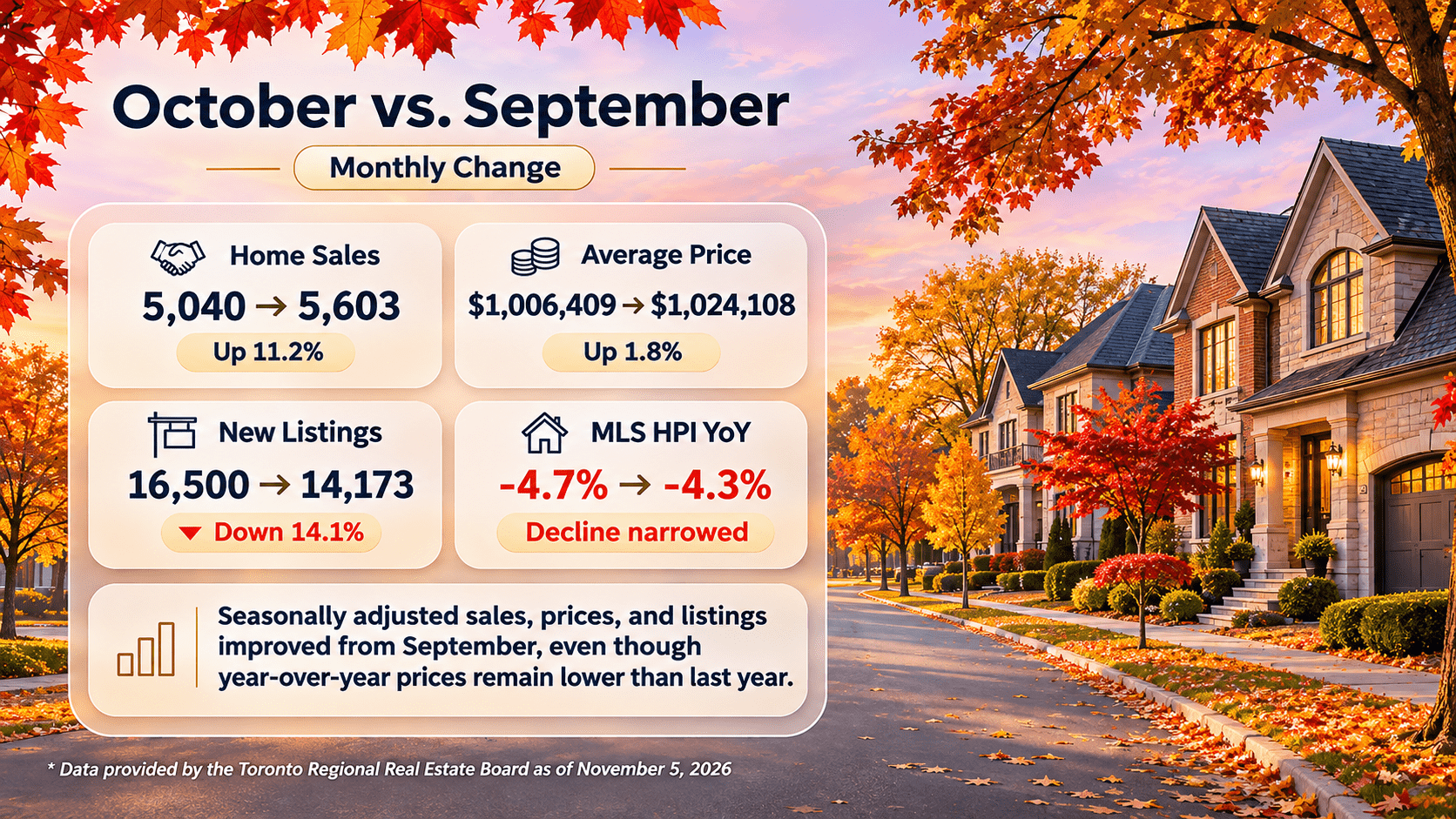
October brought 5,603 GTA home sales compared with 5,040 in September, an unadjusted increase of approximately 11.2%.

Meanwhile, the average selling price increased from $1,006,409 to $1,024,108, approximately 1.8% higher.

Importantly, TRREB also confirmed that seasonally adjusted sales and prices moved upward.

This suggests the October improvement wasn’t simply the result of normal seasonal fluctuations.

However, the broader market remains cautious.

Compared with October 2025, sales fell 7.9%, while new listings declined 11.9% to 14,173.

This combination tells an interesting story.

Buyers are still hesitant, but fewer sellers are bringing properties to the market.

If supply continues shrinking faster than demand, it could eventually help support prices. On the other hand, if economic uncertainty persists, buyers may continue to delay major purchases.

For anyone buying a home in the GTA, understanding the available inventory in their preferred neighbourhood is essential.

A slower regional market can still have highly competitive individual listings.

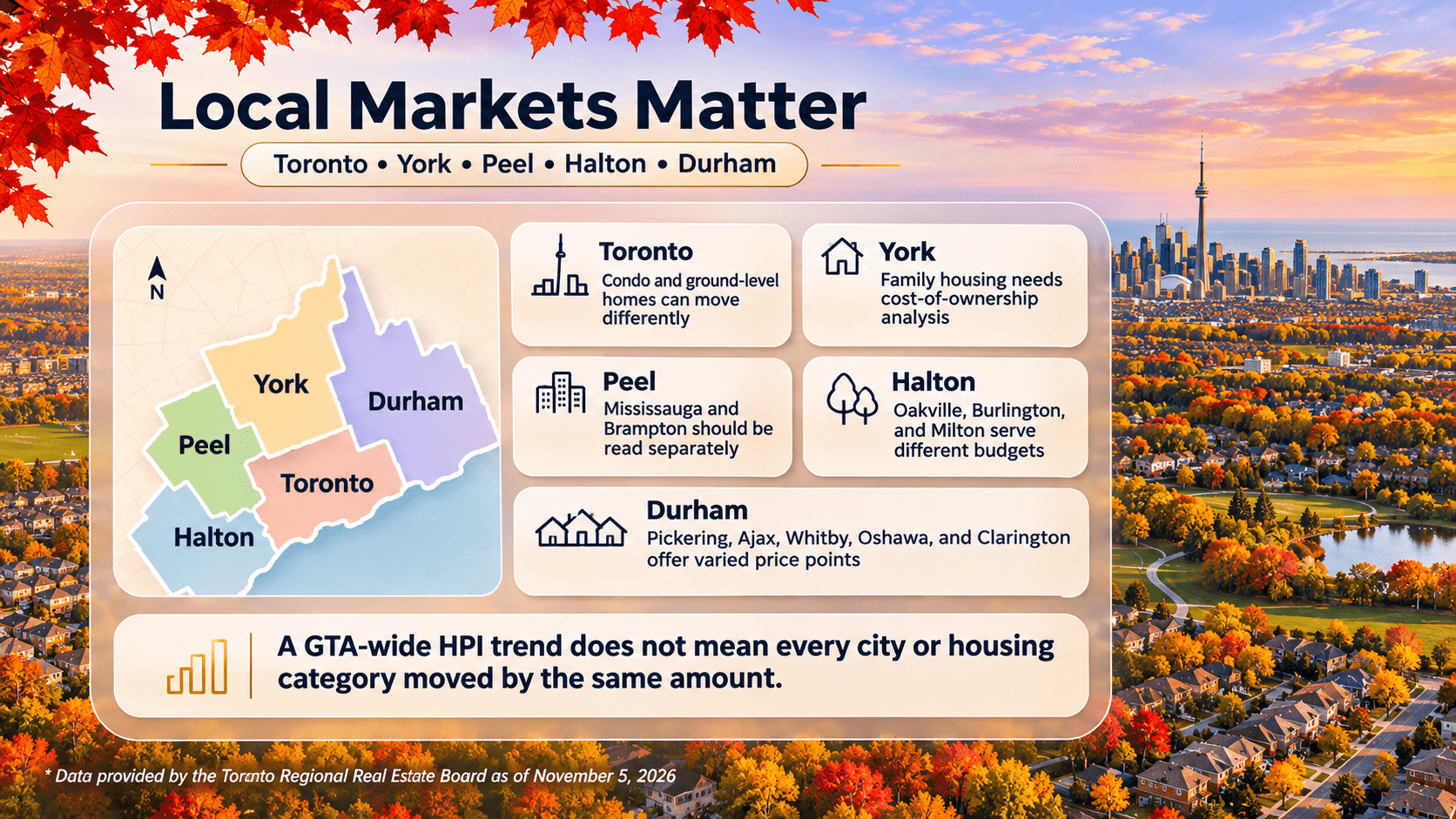
4. Toronto, York, Peel, Halton and Durham: Why Local Housing Markets Matter

The Greater Toronto Area is made up of several distinct real estate markets.

Toronto, York, Peel, Halton and Durham differ significantly in housing types, price levels, neighbourhood characteristics and buyer preferences.

In Toronto, the condominium apartment market and ground-level housing market can respond differently to affordability pressures. A downtown condo buyer may be focused on monthly carrying costs, while a detached-home buyer may prioritize schools, outdoor space and neighbourhood stability.

York Region, including Markham, Vaughan and Richmond Hill, offers a wide variety of family-oriented residential communities. Buyers here often compare detached houses, semi-detached properties and townhouses based on the overall cost of ownership.

Peel Region includes two major markets with different housing compositions: Mississauga and Brampton. Mississauga’s mix of condominium apartments and detached homes makes property-type comparisons particularly important, while Brampton’s family housing market requires its own comparable-sales analysis.

Halton Region includes Oakville, Burlington and Milton. These cities serve different budgets and lifestyle requirements, making it important to compare properties within their own local markets.

Durham Region, including Pickering, Ajax, Whitby, Oshawa and Clarington, offers additional alternatives for families looking at different locations and price points.

The key lesson is simple: a 4.3% GTA-wide HPI decline does not mean every city or housing category experienced the same change.

Before making a purchase or listing decision, buyers and sellers should review city-specific benchmark prices and current market inventory.

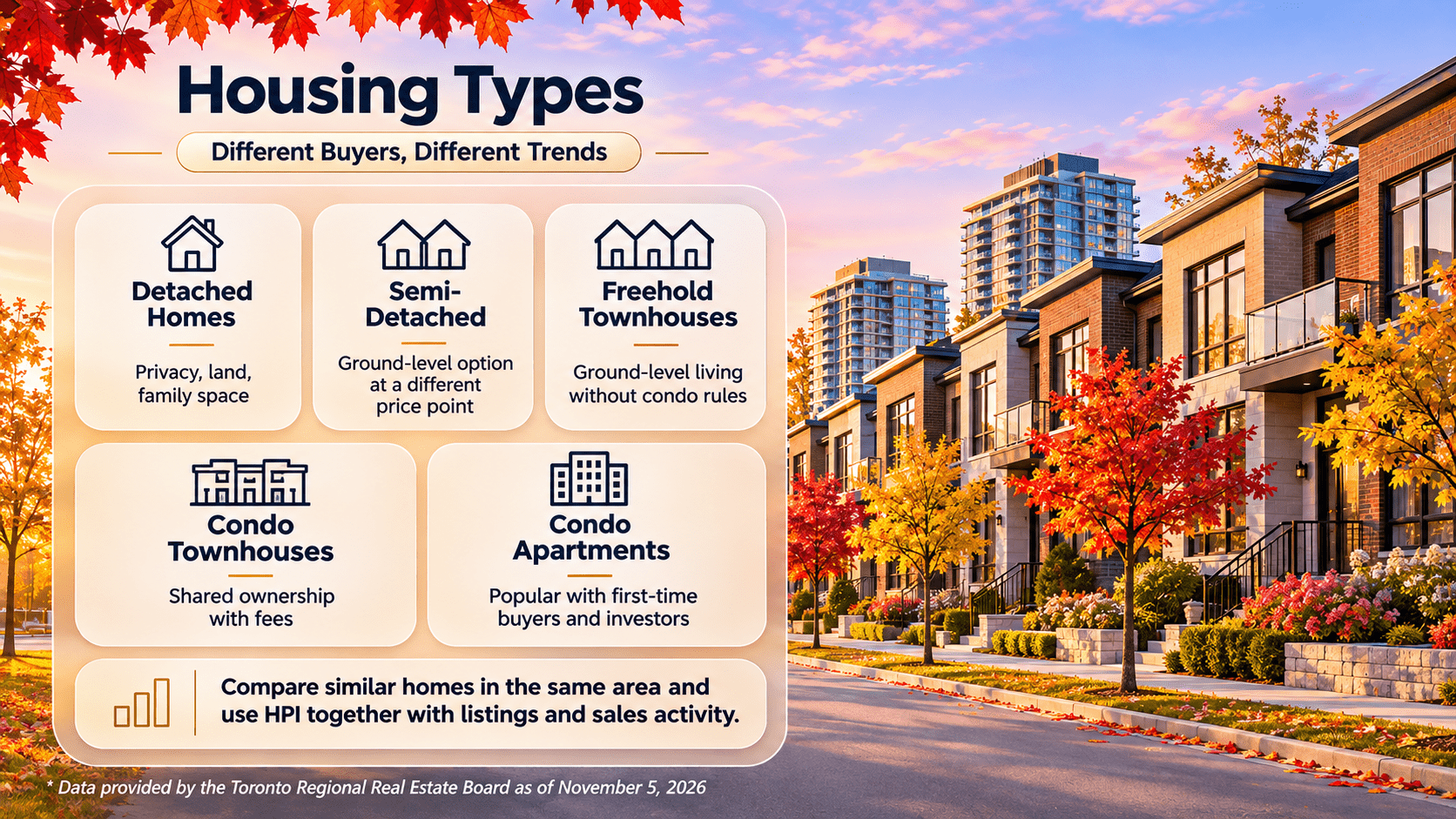
5. Detached Homes, Semi-Detached Homes, Townhouses and Condos: Different Buyers, Different Trends

Not all housing types react to market changes in the same way.

Detached houses often attract families seeking privacy, more living space and outdoor areas. Semi-detached homes offer some similar benefits at different price levels.

Freehold townhouses may appeal to buyers who want ground-level living without a condominium ownership structure, while condo townhouses can offer another option with different maintenance responsibilities and monthly expenses.

Condominium apartments, meanwhile, attract first-time buyers, downsizers and investors.

These differences matter because each category can have its own supply-and-demand dynamics.

A buyer looking for a two-bedroom condominium apartment in Toronto is not necessarily competing with someone searching for a detached house in Richmond Hill.

Similarly, a freehold townhouse in Milton should not automatically be compared with a condominium townhouse in Mississauga.

When evaluating the market, the most useful approach is to compare similar properties within the same area.

It is also important to understand the limits of the available data. TRREB’s HPI categories do not always correspond perfectly to the five transaction-based property types used in its monthly sales reports.

For that reason, detailed market analysis should use property-specific HPI information where available and supplement it with separate transaction statistics rather than treating all townhouses as one identical investment.

6. GTA Buyer and Seller Strategies: What October's Numbers Actually Mean

For buyers, October’s data presents a mixed but potentially useful opportunity.

The HPI benchmark remains below last year’s level, suggesting that buyers may find more attractive pricing than during stronger market periods.

However, the improvement in month-over-month sales and prices is a reminder that market conditions can change.

Instead of waiting indefinitely for the lowest possible price, buyers should focus on affordability, suitable properties and comparable sales.

A well-priced house in a desirable neighbourhood can still attract competition, even when overall market conditions favour negotiation.

Understanding real estate negotiation strategies can help buyers structure offers around property conditions, financing and realistic market value rather than simply negotiating for the largest discount.

For sellers, October’s numbers offer another important lesson.

Although home prices remain lower than last year, the annual HPI decline is narrowing and the number of new listings is also lower.

This does not justify aggressive overpricing. Instead, sellers should position their homes competitively within their local market.

Effective professional property marketing includes strong photographs, accurate descriptions, thoughtful pricing and effective presentation.

In addition, property condition and visual appeal can influence how buyers compare similar listings.

For homeowners preparing to sell, thoughtful residential interior design can help improve functionality, presentation and the overall impression of a space.

Of course, the financial return from renovations or design improvements depends on the property, budget and local buyer expectations. Sellers should evaluate the likely return before committing to major improvements.

7. GTA Real Estate Market Outlook: What Should Buyers and Sellers Watch Next?

October 2026 provides some encouraging signs, but the market is not yet delivering a clear and sustained recovery.

The year-over-year HPI decline has narrowed. Seasonally adjusted home sales have improved. Average prices have also moved upward from September.

Meanwhile, sales and new listings remain below October 2025 levels.

These mixed signals suggest that the market may be transitioning toward a more stable environment, although economic uncertainty continues to influence buyer confidence.

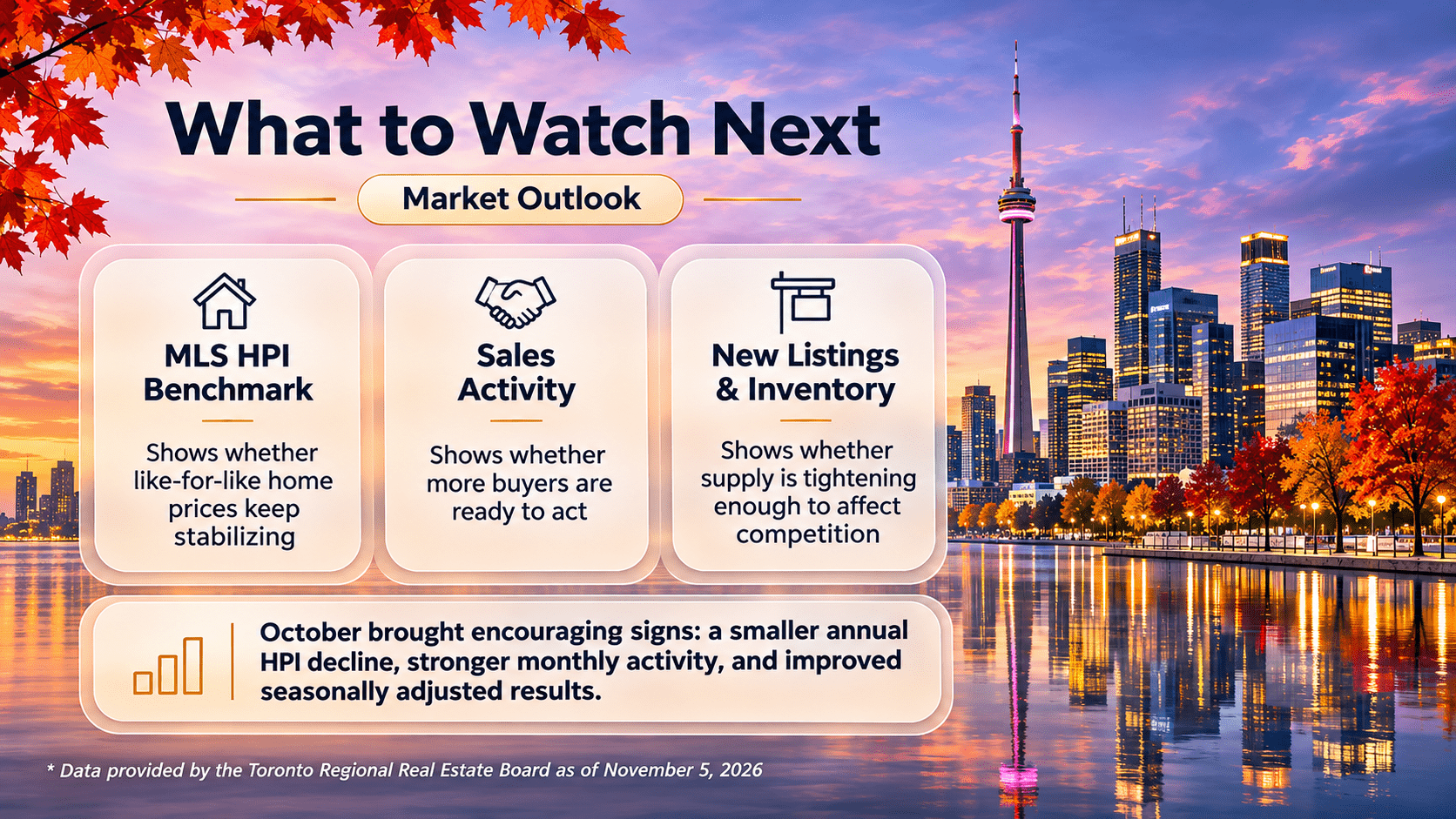
Looking ahead, three indicators deserve particular attention.

First, the MLS HPI benchmark will show whether prices continue stabilizing on a like-for-like basis.

Second, sales activity will help reveal whether more buyers are willing to act rather than simply browse available listings.

Third, new listings and active inventory will indicate whether supply is tightening enough to influence future competition.

The combination of these figures is much more valuable than relying on a single headline about rising or falling home prices.

For buyers, the priority should remain long-term financial comfort and purchasing the right property at a reasonable price.

For sellers, accurate pricing, strong marketing and a clear understanding of local competition will remain essential.

And for investors, the relationship between purchase price, financing expenses, rental income and future maintenance costs should guide decisions.

Ultimately, the October data suggests that the GTA housing market may be moving toward a more balanced phase. However, that outlook will need to be tested against November and December results.

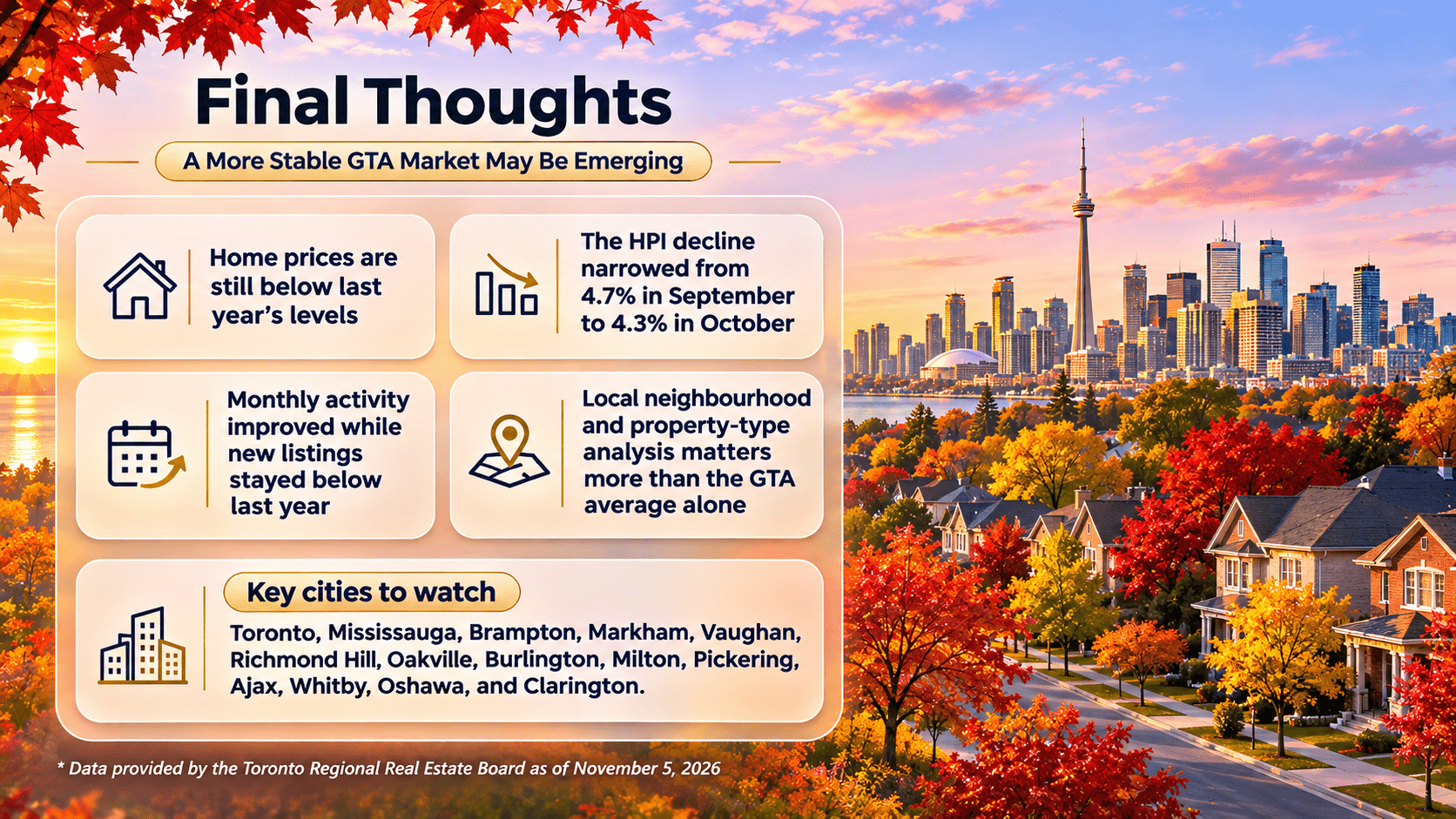
Final Thoughts: A More Stable GTA Housing Market May Be Emerging

The October 2026 TRREB statistics present a housing market that is still adjusting but showing early signs of improvement.

Home prices remain below last year’s levels, yet the annual decline in the MLS HPI benchmark has become smaller.

At the same time, improved monthly activity and fewer new listings suggest the balance between buyers and sellers may be changing.

For anyone considering buying, selling or investing in the GTA, the message is not to rush into the market or wait for a perfect turning point.

Instead, focus on accurate information, realistic expectations and a strategy suited to your specific property and neighbourhood.

Because whether you are looking in Toronto, Mississauga, Brampton, Markham, Vaughan, Richmond Hill, Oakville, Burlington, Milton, Pickering, Ajax, Whitby or Oshawa, local housing conditions matter more than the GTA average alone.

  • Data source: Toronto Regional Real Estate Board (TRREB), October 2026 Market Watch, released November 4, 2026. GTA-wide figures are verified from TRREB’s official announcement.
  • Disclaimer: The views and opinions expressed in this article are solely those of the author and are provided for general informational and reference purposes only.

Customers Say

ADAM CUI IS THE GREAT REAL ESTATE AGENT to trust

five-star-reviews-google

Learn with the best

stay tuned

Subscribe to our newsletter to see the latest blogs

Maybe you are interested in

My services for the seller include initial consultation, market analysis, free estimate, make pricing strategy, home staging consultation, repairs and improvements consultation, professional photography and videography, detailed property description, customized marketing plan, online listings, social media marketing, design and print flyers and brochures, open houses and private showings, ongoing communication and feedback, continuous market monitoring, offer management, negotiation with buyers, counteroffers and finalization, transaction coordination, closing assistance with thirty-parties, and future real estate needs assistance.

This full suite of services is designed to make the selling experience smooth, rewarding, and successful. By partnering with Adam Cui, you are getting a knowledgeable, resourceful, and committed agent who will prioritize your interests and make sure your goals are met efficiently.

My services for the buyer include initial consultation, needs assessment, property search and selection, early access to listing, personalized tours, detailed market analysis, property transaction history research, property inspection coordination with thirty-parties, review of disclosures with third-parties, negotiation on inspection findings, custom offer preparation, expert negotiation, multiple offer handling, detailed contract explanation, legal and compliance assistance with third-parties, liaison with all parties, document assistance, final visits support, homeownership guidance, and lifetime real estate support.

Through each step, my goal is to minimize stress, streamline your home-buying experience, and deliver outstanding value within my 0.88% commission. Whether you are a first-time buyer or a seasoned investor, you can count on my expertise, dedication, and personalized care to make your real estate journey a success.

No. It only applies to the buying and selling property transactions. For rental services, I will charge half of the one-month rent if I represent one party.

No. HST will be added on top of that.

As a buyer, you typically do not pay my 0.88% commission directly. This commission is generally covered by the seller in a real estate transaction.

As your dedicated real estate agent, my priority is to provide you with the best possible service and value. If a seller offers a commission greater than 0.88% for my services, I would still honor my commitment to you, the buyer, and keep only 0.88% as my commission.

The home buying process involves several steps: getting pre-approved for a mortgage, finding the right property, making an offer, and completing inspections. Afterward, you will finalize the mortgage, sign the paperwork, and get the keys. It is essential to have guidance through each step to ensure a smooth and successful purchase.

When making an offer, it is important to consider the market conditions and the property’s value. Consult with your real estate agent to craft a competitive offer. Include necessary contingencies like financing and inspections. Always be prepared to negotiate. This ensures your offer stands out while protecting your interests.

Finding the right home starts with understanding your needs and budget. I will guide you through the process, showing you options that match your criteria. Together, we will explore neighborhoods, amenities, and property features. My goal is to help you find a home where you can see yourself living happily for years to come.

real-estate-agents-shake-hands-after-the-signing
Thank you for contacting

ADAM CUI

I will reach you back as soon as possible. If you are in a hurry, please press the button below to give me a call now.